Sebastian Kosciusko: Difference between revisions
FadedForest (talk | contribs) No edit summary |
FadedForest (talk | contribs) No edit summary |
||
| Line 1: | Line 1: | ||
{{Infobox FBA biography | {{Infobox FBA biography | ||
| name = Sebastian Kosciusko | | name = Sebastian Kosciusko | ||
| Line 34: | Line 29: | ||
| draft_pick = 12 | | draft_pick = 12 | ||
| career_start=2014 | | career_start=2014 | ||
| team= | | team=SAS | ||
| contract_year= | | contract_year=2019 | ||
| team1=LVG | | team1=LVG | ||
| years1=2014-2015 | | years1=2014-2015 | ||
| Line 41: | Line 36: | ||
| years2=2015-2016 | | years2=2015-2016 | ||
| team3=SAS | | team3=SAS | ||
| years3=2016-present | | years3=2016-''present'' | ||
| awards= | | awards= | ||
* FBA Rookie All-Star ([[2015 All-Star Week|2015]]) | * FBA Rookie All-Star ([[2015 All-Star Week|2015]]) | ||
Revision as of 22:12, 22 September 2019
 art by Khed | |
| No. 47 – Santa Ana Spectrums | |
|---|---|
| Position | Forward |
| Species | Toucan ( Ramphastidae ) |
| Gender | Male |
| Nickname(s) | |
| Seba | |
| King of Eldorado/El Alado | |
| Couscous | |
| Personal information | |
| Born | Eldorado, Argentina |
| Nationality | Argentinian |
| Listed height | 6 ft 8 in (2.03 m) |
| Listed weight | 220 lb (100 kg) |
| Shoots | Right |
| Career information | |
| School | El Alado College |
| FBA draft | 2014 / Round: 1 / Pick: 12th overall |
| Selected by the Las Vegas Wildcards | |
| Pro playing career | 2014–present |
| Career history | |
| 2014-2015 | Las Vegas Wildcards |
| 2015-2016 | Williamsburg Minutemen |
| 2016-present | Santa Ana Spectrums |
| Career highlights and awards | |
| |
| Contract information | |
| Contract year | 2019 |
| Player Contacts | |
| (IC) Agent | Blake Toivonen |
| (OOC) Creator | Khed |
| (OOC) Actor | Khed |
| (OOC) Usage | Ask me before any use |
Biography
Seba Kosciusko (full name: Sebastián Demetrio Kosciusko-Galván) was born and raised mostly on the outskirts of the hilly northeastern Argentine city of Eldorado, overlooking the Paraná toward Paraguay and surrounded by the rich vegetation of the Misiones jungle. The second of five children, most of his young life was spent in poverty. His father, a black-crowned night heron of Polish stock whose ancestors crossed the Atlantic about eighty years before, worked as a bricklayer, painter, and even as a fisherman at various points during his childhood. His mother, a keel-billed toucan from Oberá -the nearby city where she met Seba's father, known for its verdure atop red-soiled hills- sometimes took on odd jobs to feed the family.
In between too-infrequent meals and classes, Seba would play with his siblings and neighborhood children in soccer games on the local field. Despite fútbol being the preferred sport of the neighborhood, he also discovered that he had a propensity for básquet. While he had decent enough agility on the field, he could never develop the power or coordination to direct or dribble the soccer ball. With his hands, however, he had more than sufficient skill to shoot, block, and dribble - of another sort, of course.
After saving for a time, he and his family were able to get him accepted into a local athletic club, where his skills soon surpassed his peers'. Both Seba and his parents saw in his abilities something more than a hobby: it was a potential escape from the family's chronic economic woes, and they would invest in it.
Shortly after he turned 14, a local labor shortage and better prospects for the family led them to leave Eldorado for the provincial capital, Posadas. Taking up residence in a much larger city was difficult socially, but Seba's sport life shot forward when he was taken on by the prestigious avian Club Sokol, a springboard from which he was able to participate in regional and even national tournaments with those his age.
While he discovered that his best talents did not lie in the flashy realm of point-scoring guards, his teammates slowly realized that on top of his above-average rebounds, Seba had an uncanny ability to limit the opposing team's capacity to score. Whenever Seba had to sit out, even though the team did just about as well as it would normally, its opponents were more likely to match or exceed their previous performance. Some assumed that the team from Club Sokol was merely lucky, but the rumor began that one of the provincianos had made a bargain with a demon to rig games in their favor. A devout Catholic, Seba tried to quash the rumors, but his opposition merely fueled the speculation and attributed the supernatural hijinks to the unamused toucan. Some even considered making pacts themselves when Seba got selected as one of the best young basketballers in Argentina.
Beyond doing as best he could basketball, Seba also had another goal: attend college, if possible in the United States. Not only might basketball help with his admission and pay for his education there, but time in America -whether from his degree or a career obtained there - would provide him and his family both notoriety and financial stability. To this end, he held his beak to the grindstone throughout secondary school; when he wasn't sweating his feathers off on the court he was immersed in his studies, especially English. Even though he was never the most brilliant student, his determination was exemplary.
In the end, he was able to land a basketball scholarship at El Alado College, a Southern California school dedicated to avian excellence with a large Ibero-American contingent in its student body. Having been recruited for the basketball team, he immediately began preparing on arrival, surprised by the quality of the college's training facilities and the nonchalance of many of his teammates. When his teammates heard about his place of origin, they nicknamed him the "King of Eldorado" - an epithet which, at first to Seba's consternation and later to his amusement, stuck. The variant “King of El Alado” came later.
One benefit of El Alado, furthermore, was that Seba's older cousin Danny Almirón, whose parents had moved to California from Argentina when Danny was very young, was also in school there. Danny, in his senior year when Seba began, lived close enough to El Alado that after fulfilling his year at the dorms, Seba was able to move into Danny's apartment, whence he would leave early every morning and return late at night. Classes, homework, practice, and a part-time job to pay for expenses beyond tuition and to help out his family occupied nearly all of his time, and Danny rarely saw him outside of his bed or a textbook on organic chemistry or immunology.
Even though they were of a feather (their mothers were sisters), flocking together proved a challenge. Seba's hard-nosed frugality and experience of poverty gave him a sober outlook that clashed with his cousin's laid-back, contented manner, which Seba attributed to a spoiled American childhood. Danny attempted to bridge the gap by attending some of Seba's games, but this somewhat backfired, as it was seen as a reminder of his leisure time. He proposed working out with Seba, but Seba's studies and Danny's work in the admissions office meant that they could never coincide. Seba never had time or interest, either, in the games of touch American football Danny enjoyed so much.
While he had prepared for a medical career –something he could do either in America or Argentina– Seba decided partway through his college career to seriously attempt for a spot in Furry Basketball Association draft upon graduation in 2014, something he had thought out of his reach before. He carefully balanced his skills, keeping an eye on his competitors from around the world to best leverage his own strengths. He did not care about the stardom that would come with professional sports; for Seba, the attempt at the FBA Draft would be the dream of the young bird in Eldorado, watching grainy footage of his heroes and trying to replicate their moves on the court down the street. Though unwarranted feelings of insufficiency sometimes overtook him, he had resolved that he would try it, and he worked tirelessly for his new goal.
His work paid off when he was selected as player of the year at El Alado in addition to being team captain. Though his team had originally confused his quietness for misanthropy, they came to appreciate his keen analytical mind, capacity for organization, and dogged determination. Furthermore, though his school was often overlooked in college basketball commentary, during his time the El Alado Phoenixes rose from the metaphorical ashes to their first winning seasons in years. Recognizing Seba's contributions to this turnaround, El Alado's league selected him as one of their all-star players.
With only graduation and the draft lying between him and the rest of his life, Seba hopes for both the realization of his childhood daydreams -now in reach- of playing the sport he loves as a career and helping repay with gratitude his family's constant support of his efforts.
Notes on Personality
Seba is a perfectionist: his method of dealing with uncertainty is to master a skill so thoroughly that he cannot be questioned. He operates best under sets of clear - or relatively clear - rules. Once he knows the rules, he can abide by them and express creativity within their bounds, but either way he feels comfortable knowing the bounds of good performance and excellence. If he knows what he wants and how to get there, nothing can stop him. This is one reason why sports are a refuge for him. He feels that he has fine-tuned control over his body in a game, a sensation he finds very satisfying. And even though there is a lot of randomness, human error, and improvisation, the game is structured in a way Seba understands and which he can manipulate for his (and the team's) own good. This is one reason why he's become very good at directing the team: even if he isn't the most socially adept person, he knows from observation and study how people and teams interact and can plan accordingly. It's also one reason he finds comfort in his faith: it is very orderly, no pun intended, and allows for clear absolvement of guilt if needed.
His problem, then, lies in circumstances where he doesn't have the mastery needed for control of the situation. He's gotten accustomed to the insecurities of the court so that when a game isn't going his way he can adapt, but negotiating new social situations and major life transitions often proves daunting for him. When there is something far outside of his comfort zone on the horizon, moreover, his anxiety about it can seep into other aspects of his life. If he believes himself to have made a large mistake, it is likely that he will relive that moment over and over in his mind, creating safeguards so that it will never happen again. Most often these supposed infractions stem from a belief that he neglected some sort of duty: to his team, to his teammate or friend, to his family back home.
Given these barriers, Seba sometimes finds it difficult to make and maintain friendships. He isn't antisocial by any stretch of the imagination, but sometimes he feels that recreation or social interaction without a defined goal is a luxury he literally cannot afford - the consciousness of his precarious financial situation is his sword of Damocles. Frequently this leaves him lonely, an emotion to which he has been practically desensitized; as a consequence, anyone who puts in the time and effort to befriend or care for Seba will be met with bafflement or, after he realizes their sincerity, deep gratitude he will have trouble expressing.
Stories
| What One Can't Written by Khed © Khed |
|---|
| The apartment door clicked shut behind Seba. Without looking, he slouched against the door, reached his arm across his chest, and turned the deadbolt. He took a deep breath, hoping that the darkness behind his eyelids would turn out to be the ascent from sleep to wakefulness.
He opened his eyes and the apartment, walls and furniture yellowed by nocturnal incandescence, didn’t disappear. Despertate ya, che. On the table and in the sink lay the detritus of a meal, half-eaten and half-cleaned up. In Seba’s peripheral vision, he saw his cousin Danny sat slumped in the living room’s sunken-seated couch. The basketball game on the television –some FBA matchup– occupied the other toucan’s attention wholly. Upon hearing the door open and close, Danny turned with his trademark grin. “Back a little late from groceries, eh?” You could always hear the glisten in his eyes, even over the phone. It was that irrepressible, sometimes exhausting, cheerfulness of his. Well, let’s test its resilience, eh? Seba didn’t have his cousin’s capacity to project optimism – just strength, and only when he was feeling strong himself. Now was not one of those moments. Danny’s perceptiveness caught on fast. “Um… You look like you just lost a game. What’s up?” You won’t be able to hide it for long. Get it over with. Of course, the wreck itself wasn’t the worst thing… but nothing to do about that now. Sigh. “I… had an accident.” Danny tilted his head, staring at Seba quizzically. “An accident? Your shorts look dry, though!” He let out a low chuckle. Seba snorted, half from embarrassment when he got the joke and half from hesitation at the worse truth. “No… not that. Ni siquiera! It was an accident … with the car.” Danny sat up straighter, ditched the grin, and muted the television. “The car? What happened?” “Well.” Seba crossed the room, tossing his duffel bag off toward his room and dropping his grocery bags onto an area of the table he cleared hastily with the sweep of an arm. Pulling up a chair and falling into it, he faced his cousin. Whose car it was. Who had bought it with his money and permitted Seba to use it when needed. “Someone hit me from behind at a stoplight. The back bumper and the … trunk? … door are bent. It didn’t hurt the rest of the car. You can still drive it. But… it does not look good.” He paused. “They said it would require maybe one, two thousand dollars to fix it…” Before he selected a spot on the scuffed linoleum as the sole object of his visual attention, Seba saw Danny’s eyes fall and his arm rise to rub the back of his neck. “I’m sorry, it is my fault, I was not doing something right, I have not driven enough here to have adequate practice…” He closed his eyes and rubbed the palms of his hands against his eyelids, as if scrubbing the sight of the damaged car from his corneas would reverse the crash. “I thought about insurance, but it isn’t my car and I don’t want you blamed for my mistakes. It’s my fault, I will pay for it. I have the money, I’ll pay…” There was a long silence in the dark, punctuated by his own deep breaths, before Seba heard footsteps and felt a hand on his shoulder. “Seba,” he heard Danny’s smooth, unexpectedly measured voice say somewhere above and in front of him, “It’s okay. You can get in wrecks that other people cause. You’re not legally responsible for this one.” Seba flinched away from the touch. He glanced between his fingers up at his cousin’s dramatically foreshortened beak. “And, you know, I can drive a beat-up car for a bit. It’s not even the best car anyway. I can even pay for it.” It took Seba a while to process what Danny was saying. It was nothing he expected. It wasn’t right; he had been driving; he should pay. Besides, this was something that he could be accountable for, that he should pay for. He had the money, and he would pay. He had to. He didn’t meet Danny’s eyes, but his words took on an edge they didn’t have before. “No, you can’t pay for it. I’ll pay for it. I have enough.” “Hey, buddy, you don’t need to. I can pay…” At least, Seba looked up, eyes hard. “Of course you can pay for it. The American with the steady job, with the savings account and the stocks, with a laugh and a smile and no one depending on you. I don’t have enough reminders of these things. I need one more.” Danny withdrew his hand, beak falling slackly open. “Hey, just because my parents came here … different circumstances in life, that’s all… it happens…” Seba stood, over a head taller than his cousin. “Different circumstances that make you not understand what it signifies to lose things. Or to almost lose things all the time. To not have enough for the things you need. And I mean things you need. Not luxuries. Food. Shelter. Transportation. A future.” He paused, rubbing along the upper ridge of his beak with his eyes crammed shut. “I came here so I wouldn’t need charity anymore. That I could stand on my own, and that my family could stand on my shoulders, and I could pass it on to other people. I don’t need your help. I can’t need it. I can … ‘get by.’” “You can get by, sure. But get by with what? Weren’t your savings to go back to Argentina and explore draft prospects this summer? Where would paying for the car leave you?” “You don’t have to rub it in. Like I said, sometimes you lose. Life’s a game, and sometimes the other team wins.” He let that hang, a frozen silence. “I’ll take it to the shop tomorrow.” With that, Seba snatched his bag and tramped into his bedroom, shutting the door with uncharacteristic force. Danny stood bewildered in the kitchen. After a moment, he adjusted the now-vacated chair and began to empty the forgotten grocery bags. --- This time when Seba closed the apartment door he was blocking out slants of afternoon sunlight. His shoulders hung in a resigned slump from his neck. The couch was unoccupied and the table still a mess. He had left the house to work out early that morning and had not yet seen Danny, who must have still been at work, which he sometimes had on Saturdays. He hadn’t yet responded to the text Seba sent after leaving the car with the mechanic who had given him the best quote for repairs. Apparently, Danny had biked to work. Seba then saw that the table had a clear spot on it near where he had been sitting last night. He realized with a start that he could not remember taking care of his groceries and quickly ran over to his cabinet and the refrigerator. Everything was there. His fruit was carefully arranged in a bowl atop the counter. He must have had a lapse in memory. It had not been a good night. But he couldn’t spend too much time moping. If he was going to see his family in person anytime soon –not over Skype, with them calling from some telecabina– he would need a second job for the summer. And perhaps a third. Not to mention the travel and hotel expenses involved in visiting teams all over the country, hoping that someone might be interested in a relatively good basketball player. He wasn’t going to count on that, though. Basketball had given him all he’d ever planned so far and more: a means to attend an American college as well as cathartic emotional cleansing and some close camaraderie. A little voice suggested that perhaps his team would or could help out; but no, countered his mental legislator, begging for assistance is taking advantage of friendship. He opened his laptop and was about to sit down at his desk when he noticed an aberration in his otherwise well-ordered room. A paper sat on his bed. He had not put that there, and the handwriting on it was none but Danny’s blocky, irregular (American) handwriting. He stepped over and picked it up. Hey Seba. Sorry about last night. I stayed up thinking about what you said long after you went to bed. I saw you were getting into one of your sulky moods, I wanted to nip that in the bud! So I decided to write you this letter, if only because you can’t argue with a letter. I think I realized a few things about you. One, and this is a good thing: you hate avoiding any of your responsibilities. But two, you sometimes think that you’re more responsible for things than you are, and three, you try to punish yourself for failing. You don’t need to do that. Life’s hard enough as it is. You know that better than me. But sometimes we all just need a little bit of help. Trying to be independently responsible for everything can just leave us lonely. Wasn’t it you last Sunday who was going on about the Trinitarian God being a model of “relationality” or whatever? Don’t forget that you’re not alone, and that independence doesn’t mean that you have no friends. You have a great family. Even I know a little bit of what they mean to you. You shouldn’t miss seeing them this summer for something as small as a scratched bumper. You’re also a great ball player. You know, if you get drafted, this bumper, your airfares to Argentina, and even your student loans will disappear overnight. And even if it’s a pipe dream for most furs, a pro career isn’t impossible for you. Don’t give up your chance at stardom because you want to pay your own way, all the way. (And even if you don’t get drafted, you’ll be a great doctor. It’ll just take a little longer to pay stuff back.) So I’ll let you pay for the bumper. But I’ll pay for your travel expenses. I have the funds. You can put them to better use. I did a little research, and the envelope contains a check that should cover what you need for the summer. Thanks for being awesome. Danny There had been an envelope underneath the paper; Seba hadn’t noticed until the letter mentioned it. He glanced inside. It was… more than enough. “You got back later than I expected.” Startled, Seba looked up to see Danny, subtle smile on his face, leaning on the door jamb. He felt somewhat violated. He didn’t even know how to feel about all… this, and here his unrelenting benefactor appeared in his moment of vulnerability. “No tenés que… You do not have to…” “Of course I don’t have to,” Danny laughed. “But I want to. And I will not let you pay me back!” Seba opened his beak to protest, but stopped. Looking at his cousin, Seba felt something shift inside. If he met this determined resistance on the court, he would try to push right past it. Even the most tenacious defender can be overpowered or out-dodged. But maybe his opponent here was not an opponent. Maybe the basket was not on the other side of Danny, just beyond him. Maybe Danny was trying to pass him the ball. Maybe there was something between dependence and independence, credit and debt, home and visitor: togetherness, assists, mutual defense, encouragement… The light coming in through the window, previously stark with rigid beams of dust motes, slowly shifted to an embracing warmth. He sat down in his chair and managed to look up at his cousin, forcing out a few words. Forcing them not out of obligation, but because they had to push through the thick walls he had built around his innermost feelings. “Thank… thank you.” Somehow, he also managed a sliver of a smile. Danny smiled. “No hay por qué!” He began to exit the room but stopped mid-step. Turning around with a bemused smile, he asked, “So, do you want to know the moral of the story?” “The moral of the story?” Seba asked, confused at this non sequitur. “Yup! The moral of the story. Ready? Brace yourself.” Seba nodded to humor him and satisfy his curiosity. Danny straightened his back, cleared his throat, and put on his most pretentiously professorial tone and expression, lifting a finger as if he were pointing out the truths of the ages. “What one can’t, two can.” After a glance at Seba maintaining his feigned airs, Danny broke into a giant grin and jazz hands. Seba let out an exaggerated sound of derision and threw a pillow at Danny. But he couldn’t suppress a smile. |
| La Vuelta Written by Khed © Khed |
|---|
| [Events below take place approximately August 26, 2014.]
The city of Eldorado resembled from above the skeleton of a giant anaconda. Seba had thought so ever since, heady on Horacio Quiroga, he first saw a map of the place. The anaconda, he had explained to a friend once while they both bent over a map, had its head dipped in the Parana River, its tail vanishing 15 kilometers into the jungle, and its narrow midsection bisected by Ruta 12. The anaconda had been roadkill, he explained. Development had scoured away the canopy—its scaled skin—and revealed the brilliant, blood-colored soil that ran in the hilly streets during summer rains. All cities, Seba later learned, were built at intersections of some sort or another. But here, in this place, were his intersections: Europe and the Americas, his parents, himself and basketball. And he was here again for the first time in eight years. After an early bus ride from Posadas, he had stopped by the local athletic club to meet the sprightly young athletes there. Many of them had watched the Combine Challenge the previous week in large part because he—el dicho rey de Eldorado—had been on the television. In his presence they were transfixed, and Seba did his best to reassure them that he had no mystical powers, that he was just like them, that they could do what he did if they wanted. And, he added, that whatever they decided to do, it was great; after all, he himself had prepared to go to medical school had basketball not worked out. After a couple pictures and a Club Eldorado jersey as a gift, he waved farewell, watching as their awestruck eyes followed him out the door. He had one more place to go. And were he frank with himself, he would have realized that this was, perhaps, the primary reason to stop by Eldorado, especially since he no longer had family there. It was no Itatí or Luján or—que Dios tenga misericordia—Mercedes, but it was a shadow of a pilgrimage. Coincidentally, though, Seba chuckled to himself, it was to a church. Leaving Danny at a café downtown, Seba boarded a bus that took him kilometers west, toward the river. One disadvantage of being an uncommon species with an undisguisable feature—toucan beaks were impossible to hide—was that despite pulling his purple Alado hoodie over his head, he could not escape the attention of the public. Over his college career he had grown accustomed to strangers recognizing him, but since declaring for the FBA Draft the number of strangers who knew who he was had exploded. Subconsciously he had suspected greater anonymity in Argentina, but the opposite turned out to be true. Had he reflected for more than a second, he would have recalled the general enthusiasm whenever an hijo patrio attained international attention. The basketball now wedged under his arm only made identification inevitable. Wanting a modicum of privacy, he simply turned away from the prying eyes and watched the scenery pass by. Gradually, the buildings of centro and industry gave way to homes, which diminished in size and density until, Seba knew, they were approaching Avenida Bertoni. Rising from his seat, Seba pressed the button to signal a stop and descended from the back of the bus. He had been a tall child, but even so the neighborhood looked smaller than he remembered it. The kiosko on the corner had a new paint job and, he remembered with some bemusement, had provided his first nickname among the neighborhood children. Ah, the joys of a Polish surname: confused furs had rendered it Kiosko[i] or [i]Couscous, the latter coined by T. Matt Latrans during the coverage of the Combine Challenge and an instant hit among reporters. While he purchased an alfajor from the kiosko’s attendant—a nostalgic splurge—he decided he preferred Couscous[i/]. In no rush, he walked down the street munching the thick chocolate-and-[i]dulce de leche confection. The houses and pavement bore the red-stained facades characteristic of buildings exposed to the Misiones weather and left unscrubbed, the same stain that colored his feet every day of his youth. There was his childhood home, now obviously occupied by others and painted a different color; stopping in would might have be welcomed, but he wasn’t quite in the mood for company at the moment. Besides, it was no longer a part of his world. His family lived elsewhere, and it was the people, more than the place, that were important in that regard. No, was he came for was ahead: behind a tall black metal fence (gate, as always, locked) and beside a long, low, peak-roofed rectangle of a building sat an expanse of cracked, iron-tinted concrete. On either end of the concrete stood a black pole, a beaten backboard, and a netless hoop. There had never been nets, but there had never really been a need. In the years before he enrolled at Club Eldorado, Seba had only ever played with a handful of other furs here. Most of his peers just went for fútbol in the empty lot down the street. Looking a little more closely, he now saw that the church was a Mormon one. Jaja, Danny would be amused at that. The Mormons got me into basketball. After peering at the small court through the fence’s bars for a moment or two, Seba tossed his ball over the top and, not waiting for it to bounce to a halt, reached up and pulled himself over the fence. Being two meters tall made that quite a bit easier. Landing in the grass on the other side, he was about to run over to retrieve the runaway ball when a new memory, one in the flood that had assaulted him, rushed back: he had never played on this court with shoes on. In fact, much of his young life had been spent barefoot, his only shoes preserved clean for use at school. Sitting down, he bent forward and unlaced his shoes, leaving them and his socks by the wall of the church. The grass and the soil were hard and scratched against his feet, but it was deeply familiar. The trouble with sight, he later thought, was that there was too much of it in one’s memory; it was hard for a sight to stand out. But something like touch—not by the hands—had the potential to recall moods and emotions. For now Seba did not feel like the FBA draft candidate, brain stuffed with plays and muscles tuned by years of drills, but the ten-year-old with an oversized, overworn basketball shooting hoops in the afternoon sun. And that was what he did now. At first cringing from the heat of the concrete, he took his place in front of the hoop, aimed, and tossed the ball upward. An expert follow-through plunked the ball into the metal ring and a couple paces gave him the rebound. So he continued, unaware of the world, landing nearly every basket he attempted—a feat that he knew would have left little Seba jealous. Then behind him he heard the unmistakable sound of bouncing rubber and, turning, saw a ball pass by him and come to a halt at the edge of the court. It had not come from the fence, but the brick wall that ringed three-quarters of the church’s property. Picking up his own ball and standing, he inspected the top of the wall. Surely enough, as he watched he saw a little hooved hand reach up and over to grip the brickwork. A second longer revealed the large-eyed face of a young deer clambering over. Another second and those eyes widened, having noticed Seba there. The fawn froze, obviously trying to assess the situation and decide whether it would be better to abandon his ball and run or to finish scaling the wall in full view of someone who, for all he (or she? the fawn had no antlers) knew, could get him in trouble. Seba tried to defuse the tension with a smile and a wave, asking, “So, that is your ball?” The face above the wall nodded silently, eyes still wide. “Bien, come and get it! Maybe I could show you a few things.” Weighing the situation a moment more, the deer strained to lift himself over the edge but achieved it, spinning and deftly dropping onto the lawn below. Seba walked over to the youngster’s ball and tossed it over. “Catch!” A brief fumble later, the fawn caught the ball. Seba asked his name and with the reply—Luz—found his suspicions disconfirmed: she was a little doe, not a buck. Her family had recently moved here from San Vicente, she said, and she found the basketball court here though she didn’t know who owned it. After establishing that he was not there to report her, Seba began demonstrating to her the fundamentals of the game—dribbling, shooting, ball control—and having her practice them. Her awkwardness reminds Seba of those first times he had come down here with a ball he had borrowed. He could not help but smile. But throughout the impromptu teaching session, Luz continued to look at Seba strangely, but only when she thought he was distracted. It registered marginally in Seba’s mind that she was doing this, but he attributed it to interaction between strangers and his own proven social stiffness. When he knelt down beside her to guide her in making a shot, however, she let it out: “Sos el Cuscús, no?” [“You are Couscous, no?] The question caught Seba off-guard. His private reverie on the court had washed away all sense of celebrity that had accumulated over the past months, and to be reminded of his fame—especially with such a recent nickname—was jarring. “Yes, I suppose they call me that,” he responded. The shock was legible in her face, but quickly turned into a smile. “Ah! We watched you on TV last week! What are you doing here? Shouldn’t you be playing in the FBA now?” Seba laughed and explained that he wasn’t in the FBA yet, and that he was from here… and that he had begun playing basketball on this very court. “[i]Así que, don’t underestimate yourself. Just keep playing!” Little Luz nodded vigorously, hugging her ball with arms that barely reached around its circumference. With that, Seba noticed the place of the sun in the sky and realized he should be heading back. He and Danny had a bus to catch that evening for Puerto Iguazu. He bade farewell to the little fawn but watched for half a minute while she missed basket after basket. Positioning herself right under the basket, she shot upward. Seeing where it was going, Seba leapt forward and, with one winged arm and a single flap, grabbed the ball and plunge it into the hoop. “They call that an alley-oop!” he told her with a smile, snatching the ball before it escaped and handing it back to her. On an impulse, he pulled out his own basketball. “Here. Have another one. You will wear out many in order to improve!” Luz seemed overjoyed and immediately set to shooting baskets again, this time with his ball. He said goodbye again and lifted himself over the fence. Halfway down the street he could still hear the telltale sound of ball on pavement, ball on backboard, and—once or twice—ball through hoopless rim. He boarded the bus and smiled all the way back to where he would meet up with Danny again. There were a couple times when he heard his name spoken. This time, he waved in acknowledgement. When he got off the bus, Danny examined him quizzically. “Well, you look happy.” Seba sighed. “It was nice to get some time to myself, that’s all. Visit a couple places, shoot a couple hoops.” “Looks like whatever it was, it knocked your socks off.” Seba was confused until he followed Danny’s line of sight toward his own feet, where he saw blue scales and black talons. What was unusual about this struck Seba too late: he had forgotten his shoes back at the church’s court! He started for a moment, recalling how much those shoes had cost, but just as quickly realized that he and Danny had no time for him to return to Avenida Bertoni for a pair of shoes. They were lost, and they weren’t coming back. He sat down at the café table, worry written on his face. Feelings of guilt began to well up within him. Replacing expensive things was always his nightmare, a symptom of growing up with little. But this time, it was as if they melted and flowed away in an instant when a thought dawned on him: why did he need shoes to play basketball? Plenty of fellow ballers played barefoot. Descalzo. Furthermore, as a child he never had worn them. To leave his basketball shoes on that court here in Eldorado would be a fitting tribute to his younger self. “Yeah,” he laughed at his cousin. “I suppose they did. For good. Now, let’s catch that bus.” |
Artwork
-
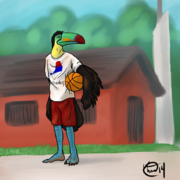 Drawn by Khed
 -
 Drawn by Khed
 -
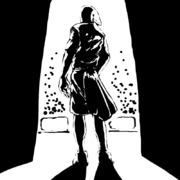 Drawn by Khed
 -
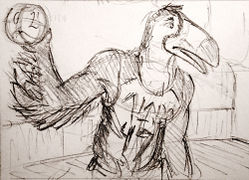 Drawn by Tym
 -
 Drawn by Adaoz
 -
 Drawn by Adaoz


2014 - 2015 Regular Season Stats
2015 - 2016 Regular Season Stats
2016 - 2017 Regular Season Stats
|